What is Tai Chi?
Tai chi is an internal art that improves health, vitality, strength, balance, posture, flexibility and circulation, as well as providing stress reduction and a number of other benefits. Often called a moving meditation, tai chi is characterized by its slow, intentional movements that are performed with complete relaxation. The art's philosophy mainly comes from Taoist principles; the lessons from class can be applied to the everyday world. Tai chi chuan includes the original martial intention of this art which can provide a deeper understanding of the principles.
Tai chi is also a dynamic form of Qi gong, a group of exercises that develop the practitioner's vital energy. Along with tai chi, we practice various other Qi gong exercises.
Who can practice tai chi?
Everyone! In fact, continued practice has shown many benefits with age.

About Yulong Tai Chi Chuan
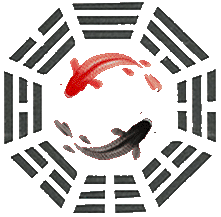
The name of the school comes from a Chinese fable. Beautiful carp (koi in Japanese and jin li in Chinese) gather at the pool below a high waterfall in the Yellow River known as the Dragon's Gate. Only the most tenacious fish, known as yulong, can swim up the waterfall and leap the Dragon's Gate, where they are then transformed into dragons. The story teaches us that hard work will lead to great rewards. To the Chinese, the fish represents success.
The Yulong Tai Chi Chuan school was also created in The Year of the Water Dragon. The school's logo is represented by the yin yang koi swimming in perfect balance. These yulong fish are contained within the 8-gate arrangement of the bagua ready to become leaping dragons!
About Guang Ping Yang
Guang Ping Yang style, also known as old Yang style, comes directly from the more forceful Chen's style tai chi and is traced directly back to Yang Lu-Chan and his son, Yang Ban-Hou. It is characterized by deep stances, and a mix of soft and fast movements. Click here to read about the history and lineage of the Guang Ping Yang style of tai chi.